Water Heater Sediment Buildup & Flushing Guide | New Orleans Plumber
Learn how thermal expansion and scale deposition cause water heater sediment buildup in New Orleans homes. Expert diagnostic and safe flushing guide.


Understanding Water Heater Sediment Buildup and Thermal Mechanics
Water heater sediment accumulation occurs when dissolved minerals—primarily calcium and magnesium carbonates—precipitate out of hard water as it is heated, dropping to the bottom of the storage tank. In New Orleans homes, where local municipal water supplies carry varying mineral loads and subterranean conditions subject supply lines to distinct temperature fluctuations, this thermal cycle continuously accelerates scale deposition. As these microscopic mineral particles aggregate over time, they form a thick, insulating barrier between the gas burner or lower electric heating element and the water volume inside the tank.
This physical separation forces the heating assembly to work significantly harder and longer to achieve the thermostat setpoint, a phenomenon that directly compromises thermal efficiency and mechanical longevity. From a system mechanics standpoint, the trapped sediment layer retains localized heat, causing intense thermal stress on the steel tank bottom. This localized overheating can create micro-fractures in the glass-lined interior, warp heating elements, and trigger premature pressure relief valve activations due to localized steam boiling beneath the sediment bed. Recognizing the early warning signs—such as rumbling or popping noises during heating cycles, fluctuating hot water delivery durations, or discolored tap water—allows homeowners to differentiate between a failing tank floor and routine mineral accumulation.
Overlooked Trade Secrets: Scale Deposition, Anode Rods, and New Orleans Water Chemistry
Standard homeowner maintenance guides frequently overlook the intricate chemical relationship between sacrificial anode rods and mineral drop-out rates. The anode rod—constructed of magnesium, aluminum, or zinc—is engineered to corrode electrolytically before the steel tank wall succumbs to oxidation. However, once an anode rod is completely depleted, the electrochemical balance shifts, accelerating galvanic corrosion across the entire tank interior and compounding mineral precipitation. In historic New Orleans properties featuring older galvanized service lines or aging municipal infrastructure, fluctuating mineral concentrations can rapidly coat the anode rod with a hard crust, rendering it entirely inactive within just a few years of installation.
Another critical oversight involves drainage mechanics during DIY tank flushing. Many homeowners attempt to clear sediment using standard garden hoses connected to the brass drain valve, only to find the flow instantly restricted. This occurs because mineral chunks and scale flakes form a dense sludge plug directly behind the valve gate or within the dip tube assembly. Forcing high-pressure water against a blocked drain valve without understanding backpressure dynamics can strip internal valve stems or rupture aged plastic drain spouts, turning a routine maintenance task into a flooded mechanical room. Furthermore, high ambient groundwater tables and saturated soils across Orleans Parish mean that any slow, undetected weeping from a damaged drain valve can quickly pool beneath pier-and-beam foundations, going completely unnoticed until wood rot or structural settling sets in.
Safe Homeowner Triage vs. Dangerous DIY Boundaries
Before attempting any maintenance or diagnostic evaluation on a residential water heater, homeowners must understand the strict boundary between safe, preventative procedures and hazardous mechanical interventions. Performing routine visual inspections, testing the temperature and pressure (T&P) relief valve lever, and monitoring recovery times are safe practices that require no specialized tools. Additionally, checking for external condensation versus active shell weeping helps determine whether moisture is simply atmospheric or a sign of tank failure.
Conversely, certain procedures present severe safety risks and should be left strictly to licensed professionals:
- Gas Line Manipulation: Never attempt to disconnect, unthread, or modify gas supply flex lines, control valves, or pilot assemblies without proper gas certification and leak-detection equipment.
- Electrical Panel Interventions: Never service electric water heater elements or wiring without confirming complete circuit breaker isolation and verifying zero voltage with a digital multimeter.
- Unvented T&P Valve Testing: Forcing a corroded T&P valve open when the discharge pipe is improperly routed can result in scalding water or steam expelling directly into living areas.
- Acid Descaling Chemicals: Avoid pouring harsh industrial acid flushes into residential storage tanks, as improper neutralization can degrade tank linings and release toxic vapors.
Realistic Repair Approaches and Decision Support
When addressing advanced sediment damage or complete system degradation, evaluating realistic repair options requires examining several structural and environmental variables unique to New Orleans properties. Crawlspace accessibility, attic installations, or tight utility closets in historic shotgun homes dictate whether a storage tank can be easily extracted or if specialized rigging is required. Furthermore, local parish and municipal plumbing codes dictate strict requirements for thermal expansion tanks, seismic strapping, and code-compliant atmospheric venting.
The following table outlines key decision criteria to help homeowners evaluate whether their water heater requires targeted component service or full system replacement:
| Symptom / Condition | Probable Cause | Recommended Action |
|---|---|---|
| Rumbling, popping, or knocking sounds during heating cycles | Boiling water trapped beneath a thick layer of bottom sediment | Professional system flush and sediment extraction; check element integrity |
| Lukewarm water that exhausts rapidly under normal demand | Insulating sediment layer preventing effective heat transfer | Flush tank; inspect and replace depleted sacrificial anode rod |
| Discolored, rust-tinted hot water originating from all faucets | Internal glass-lining failure or advanced tank floor corrosion | Full water heater replacement (non-repairable shell degradation) |
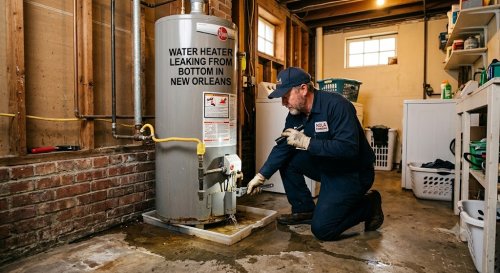
| Continuous leaking around the base of the storage tank | Internal tank wall perforation due to long-term galvanic scale corrosion | Full water heater replacement with new thermal expansion tank installation |
Frequently Asked Questions
How often should a residential water heater be flushed in New Orleans?
Due to regional water mineral content, annual flushing is recommended for standard tank water heaters. Homes experiencing heavier mineral loads or well-water integration may require semi-annual maintenance to prevent heavy scale accumulation.
Can I use vinegar to dissolve sediment inside my water heater tank?
While food-grade vinegar is occasionally used for tankless descaling, attempting to descale a large 50-gallon storage tank with household vinegar is generally ineffective due to the sheer volume of water diluting the solution. Physical draining and flushing are required for storage tanks.
What causes the loud popping noise when my water heater turns on?
The popping sound is caused by pockets of water trapped beneath mineral sediment layers boiling rapidly as the burner or element activates. As the steam bubble escapes upward through the dense sludge, it creates a hydraulic shockwave.
Why does my pressure relief valve keep dripping after a flush?
If debris or scale particles lodge themselves under the rubber seat of the T&P relief valve during draining, the valve will fail to seal completely. In this scenario, the valve must be carefully flushed or replaced entirely to prevent continuous water loss.
Does a water softener prevent sediment buildup completely?
Water softeners remove dissolved calcium and magnesium ions by exchanging them with sodium ions, which drastically reduces scale deposition. However, pre-existing sediment inside the tank will not dissolve automatically and must still be flushed out manually.
Is it safe to drain a water heater tank while the power or gas is turned on?
No. Draining a storage tank while the heating elements or gas burner remain active will cause the upper portion of the tank to overheat rapidly, destroying internal glass linings, tripping thermal switches, and potentially melting plastic dip tubes.