Water Heater Sediment Flush: Complete New Orleans Guide
Master water heater sediment flushing in New Orleans. Learn scale removal, thermal dynamics, and hard water maintenance for reliable hot water systems.


Understanding Water Heater Sediment Mechanics and Mineral Deposition
Water heater sediment accumulation is an inevitable physical process driven by thermal dynamics and mineral-rich municipal water supplies. As raw water enters a storage-tank water heater and absorbs thermal energy from gas burners or electric heating elements, dissolved calcium and magnesium carbonates experience a reduction in solubility. These minerals drop out of the liquid solution, precipitating to the bottom of the tank as a heavy, granular scale. In regions with elevated mineral content, this sediment layer thickens rapidly over time, insulating the water from the primary heat source.
This trapped thermal barrier creates severe operational inefficiency. The burner must fire significantly longer to heat the water through the insulating mineral blanket, leading to localized overheating of the tank bottom. This intense thermal stress frequently results in premature tank fatigue, micro-fracturing of glass-lined steel walls, and the characteristic rumbling, popping, or banging noises heard during active heating cycles as trapped water pockets boil underneath the sediment crust. Diagnostic boundaries require distinguishing between standard mineral noise and failing upper heating elements or dangerous pressure-temperature (P/T) relief valve discharge.
Overlooked Trade Secrets: Thermal Efficiency and Anode Rod Interaction
Standard homeowner guides often treat sediment flushing as a superficial garden-hose draining task, missing critical electrochemical realities inside the tank. One major oversight is the direct relationship between accumulated sediment and accelerated sacrificial anode rod depletion. As sediment covers the lower portions of the tank floor, it alters the electrical conductivity and galvanic corrosion patterns within the water vessel. The anode rod, designed to corrode preferentially to protect the steel tank, experiences accelerated localized consumption near the lower sediment line.
Furthermore, standard drain valves installed by manufacturers often feature narrow internal orifices that easily clog with large scale flakes, giving false assurance that a tank is empty when only a small drainage channel has cleared. Professional technicians utilize full-port brass ball valves and specialized high-pressure flush wands to break up compacted mineral beds that standard gravity draining leaves behind. Homeowners must also account for New Orleans' unique environmental factors: high ambient humidity and localized water treatment variations mean that tank maintenance intervals cannot follow generic national schedules and require proactive semi-annual inspection.
Static Pressure, Thermal Expansion, and Closed Systems
When sediment builds up, it displaces usable water volume inside the tank, reducing overall hot water delivery capacity. Compounding this, modern New Orleans plumbing installations often require thermal expansion tanks due to backflow preventers or closed-loop municipal meters. If a sediment layer causes erratic heating, water expansion spikes unpredictably. Without a functioning expansion tank or with a water heater choked by scale, static pressure surges can exceed safe operational thresholds, triggering the P/T relief valve and risking catastrophic property damage.
Safe Homeowner Triage vs. Dangerous DIY Boundaries
Routine flushing can be performed safely by property owners if strict operational protocols and safety boundaries are observed. Recognizing the difference between standard maintenance and high-risk utility intervention prevents personal injury and equipment destruction.
Safe Homeowner Steps
- Power Disconnection: Shut off the electric breaker supplying the water heater or turn the gas control valve to the "Pilot" or "Off" position at least 30 minutes prior to handling.
- Supply Isolation: Close the cold water supply valve located at the top inlet of the tank to prevent continuous refilling during the flushing process.
- Temperature Stabilization: Allow the stored water to cool sufficiently to prevent severe scalding injuries during handling and drainage.
- Hose Connection: Attach a heavy-duty, rated garden hose to the tank drain valve, routing the discharge to an approved floor drain or exterior grade level safely away from building foundations.
Dangerous DIY Boundaries
Strictly avoid unthreading damaged or stuck plastic drain valves under full system pressure, as shearing the valve body will release a high-volume torrent of scalding water that cannot be easily stopped. Never attempt to service gas supply lines, pilot assemblies, or electrical junction boxes without proper diagnostic training. Do not use industrial acid flush kits or chemical descalers on residential storage tanks unless certified, as improper neutralization can degrade tank linings and compromise potable water safety.
Realistic Repair Approaches and Decision Support
When evaluating a water heater impacted by heavy mineral scaling, property owners must weigh the labor and cost of remediation against the remaining service life of the unit. Routine flushing restores baseline thermal efficiency, but tanks neglected for five or more years often suffer from structural compromises that basic maintenance cannot reverse.
| Condition / Symptom | Probable Cause | Recommended Action |
|---|---|---|
| Popping or rumbling noises during heating | Boiling water trapped beneath thick sediment layers | Perform thorough pressure flush and inspect drain valve |
| Drastic reduction in hot water duration | Sediment displacing water volume or insulating element | Flush tank; inspect dip tube and lower heating elements |
| Rusty water from hot taps (tank over 10 years old) | Advanced tank wall corrosion and depleted anode rod | Prepare for full unit replacement; sediment has compromised steel |
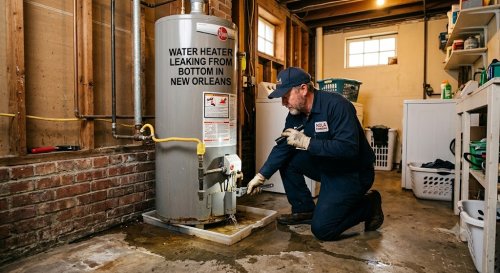
| Continuous leaking from tank bottom seam | Thermal fatigue and glass-liner fracture from overheating | Immediate unit replacement; no repair can seal a ruptured tank wall |
Repair decisions in historic New Orleans properties also depend heavily on physical accessibility. Tight crawlspaces, raised pier-and-beam foundations, and narrow historic doorways frequently complicate the extraction and installation of bulky storage tanks, making spatial clearance and local plumbing code compliance critical factors in long-term equipment selection.
Frequently Asked Questions
How often should a water heater be flushed in New Orleans?
Due to regional water mineral profiles, storage-tank water heaters should be flushed at least once every 12 months. Properties experiencing exceptionally heavy mineral accumulation or high daily hot water consumption benefit from semi-annual flushing to prevent dense scale formation.
Can I flush a water heater if it has never been serviced in 10 years?
Proceed with extreme caution. A decade of unmaintained sediment often forms a solid, cement-like crust. Opening the drain valve on such a unit can cause the valve to clog permanently with large scale debris, or worse, dislodge a scale plug that was previously sealing a compromised corrosion spot, triggering an active leak.
Why does my water heater make a loud popping noise when it turns on?
The popping sound is caused by steam boiling inside trapped pockets of water underneath the layer of mineral sediment at the bottom of the tank. As the metal tank floor overheats due to the insulating scale, the trapped water instantly flashes to steam, creating audible acoustic shockwaves.
Will flushing a water heater fix rumbling noises permanently?
If the sediment layer is successfully broken up and completely flushed out, the noise will typically cease during subsequent heating cycles. However, if the scale has baked into a hard crystalline matrix, standard gravity draining may leave behind enough material to require specialized professional descaling equipment.
What is the difference between flushing a tank water heater and descaling a tankless unit?
Tank water heaters utilize a bottom drain valve to remove loose sediment deposits from a storage vessel via gravity and water pressure. Tankless water heaters have no storage reservoir; instead, they require a closed-loop isolation valve kit and a specialized electric circulation pump to run a descaling solution (such as food-grade vinegar) through the internal heat exchanger coils to dissolve hard scale.